Department
Electrical and Electronic Engineering
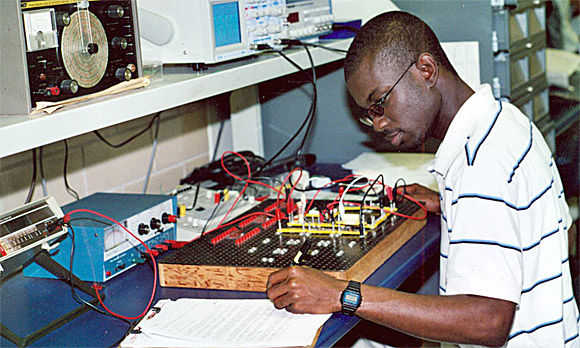
The Department's primary aim is to impart knowledge, lasting learning, and problem-solving skills to its students in Electronic and Electrical Power Engineering. It seeks to generate new knowledge and to apply both existing and new knowledge to solve challenging problems in the future, thereby improving people's quality of life. The EEE Department aims to develop and prepare professionals to lead productive lives at the cutting edge of Electrical and Electronic Engineering, and to produce well-educated individuals grounded in the fundamental concepts of power systems and electronic engineering.
The aims and objectives of the University Diploma of Technology and the Bachelor programme are:
- To produce graduates who are well educated in the fundamental concepts of electrical and electronic engineering.
- To produce graduates who are capable of continuing their professional development throughout their careers by combining theory with its application in electrical and electronic engineering practice.
- To build human resource capacity in the electric power engineering and electronics discipline, in both the public and private sectors, for students who wish to become proficient in developing traditional and renewable energy systems using a methodical approach.
- To produce graduates with good communication skills, capable of functioning responsibly in diverse environments and able to work within teams, whether within the field or multidisciplinary.
- To produce graduates who are creative, innovative, and capable of creating jobs.
On completion of the programmes, graduates should be able to:
- Control, maintain, and repair electrical installations, electrical machines, and electronic systems.
- Design and produce prototypes in the domain of electrical and electronic engineering.
- Explain processes involving microprocessors, microcontrollers, servomechanisms, and the like.
- Collaborate with senior-level technicians and engineers.
- Set up experimental arrangements and maintain electromechanical systems.
- Build electronic modules based on microcontrollers for monitoring and/or controlling processes.
- Carry out maintenance work on production and transformation chains.
- Create and manage a small enterprise.
- Write activity reports.
- Lead a team in industry.
- Present a problem, the methodology to resolve it, results, and perspectives
Programmes offered
Year 1
-
Entrance exam
Bioenergy Engineering (BEE)
B.Tech · 4 years
-
Entrance exam
Electric Power Engineering (EPE)
B.Tech · 4 years
-
Entrance exam
Renewable Energy Engineering (REE)
B.Tech · 4 years
-
Entrance exam
Renewable Thermal Engineering (RTE)
B.Tech · 4 years
-
Entrance exam
Telecommunication Engineering (TCE)
B.Tech · 3 years